Strengthening Quality and Accountability in Humanitarian Action ... From Technical Capacity Building to Institutional Commitment
As part of efforts to improve the quality of humanitarian work and enhance institutional accountability, the importance of building the capacities of organizations working in this field at various levels becomes apparent, starting with developing technical knowledge of humanitarian standards, through strengthening the role of administrative leaders in adopting and consolidating them within institutional policies, and finally preparing cadres capable of transferring this knowledge and transforming it into sustainable practices.
In this context, GOPA-DERD’s team, in partnership with Arbeiter-Samariter-Bund (ASB), implemented a series of specialized workshops and training sessions within the project “Strengthening Organisational Accountability Policy Frameworks of Syrian NGOs”, with the aim of supporting the capacities of organizations and developing their institutional and policy frameworks in line with the Core Humanitarian Standard of Quality and Accountability (CHS) and Sphere standards.
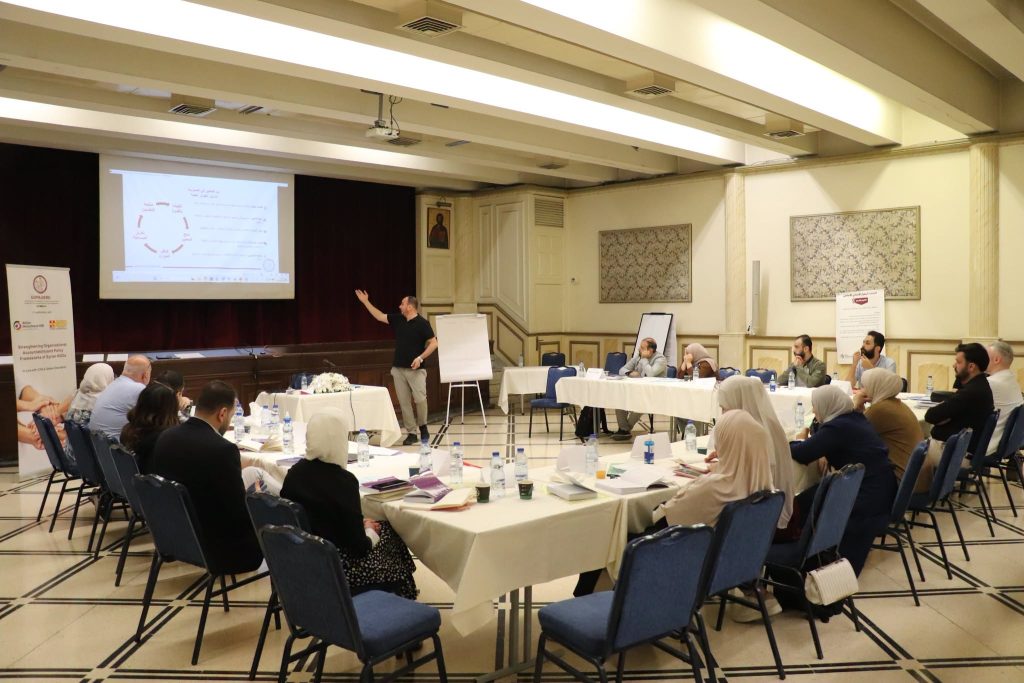
The first workshop included specialized technical training that lasted for three days, with the participation of 20 trainees representing local and international organizations. This training aimed at enhancing the capabilities of senior administrative and technical staff in local and international organizations to translate the requirements of (CHS) and Sphere standards into practical policies, procedures and practices applicable at the institutional and program levels.
The training focused on enhancing understanding of basic humanitarian standards and mechanisms for employing them in developing institutional policies and improving administrative and programmatic practices, thereby contributing to the consolidation of the principles of quality and accountability, and supporting the transition of organizations from theoretical knowledge of standards to their practical application in their institutional systems and humanitarian programs.
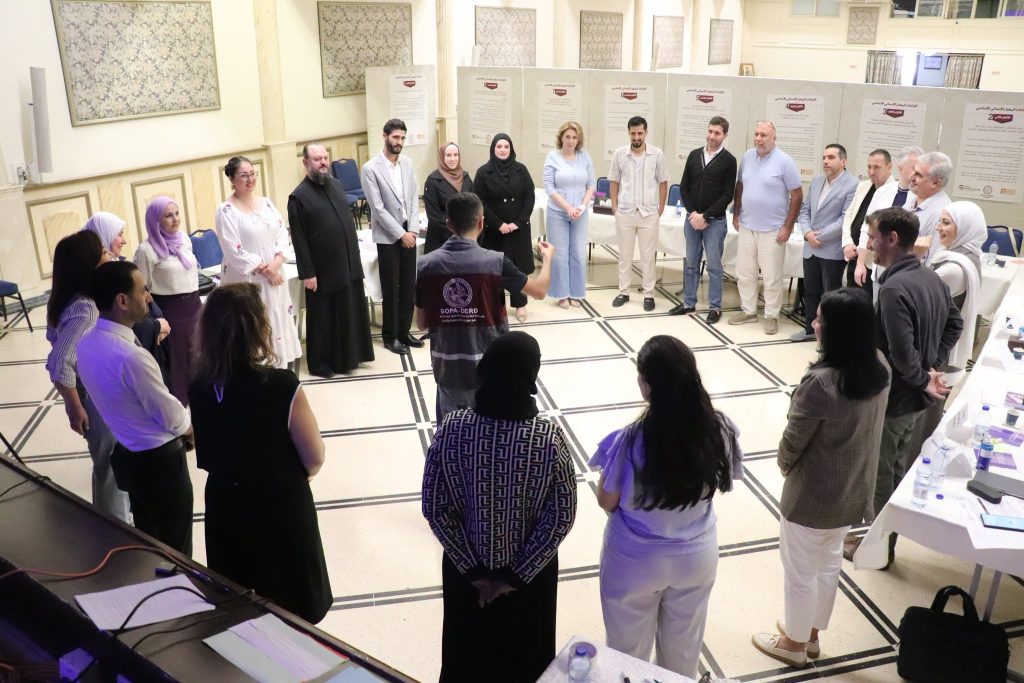
This approach extended to the leadership level in organizations, based on the importance of the role of senior management in transforming humanitarian standards into clear institutional commitments, and translating them into applicable and sustainable policies and procedures.
In this context, GOPA-DERD’s team, implemented the second workshop over two days, which targeted executive directors within 20 local and international organizations.
The workshop focused on the importance of leadership in transforming humanitarian standards into clear institutional commitments, reflected in policies, procedures, decision-making mechanisms, and resource allocation.
It also provided a space to enhance shared understanding between administrative leaders and technical teams regarding the importance of reviewing and developing internal policies to ensure the systematic and sustainable application of humanitarian standards at both the institutional and programmatic levels.
The workshop addressed the importance of integrating quality and accountability requirements, as adopted in the Sphere Handbook and (CHS), across all stages of the humanitarian response lifecycle, from planning and program design, through implementation and monitoring, to evaluation and continuous learning.
It also highlighted the responsibility of senior management to provide the necessary resources to implement the required changes, strengthen monitoring and evaluation mechanisms, and use lessons learned to improve the quality of humanitarian programs and responses.
Through these efforts, GOPA-DERD, along with its partners, seeks to promote an institutional culture based on quality, accountability, and continuous learning, and to support organizations in moving from theoretical commitment to humanitarian standards to integrating them into policies, practices, and programs, thereby contributing to providing higher quality and more effective humanitarian responses and enhancing accountability towards communities affected by crises.
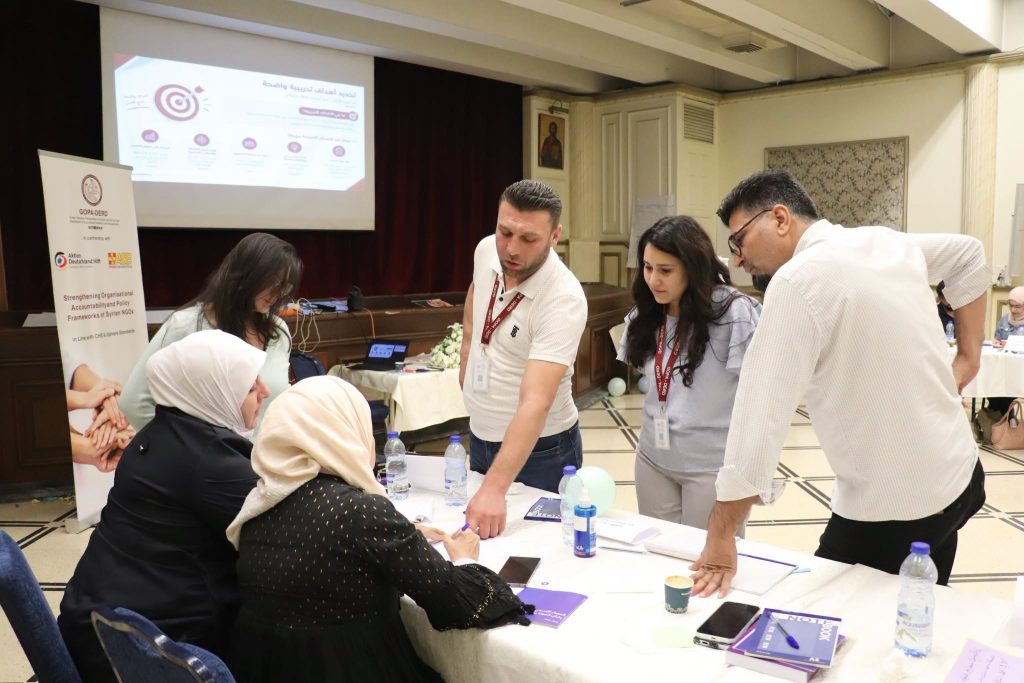
In parallel with embedding these standards within institutional policies and practices, efforts were directed towards preparing facilitators with the necessary knowledge and skills to transfer expertise to their colleagues and expand training within their institutions, thereby supporting the continued application of the standards and the dissemination of quality and accountability-based practices.
Based on the importance of integrating technical, administrative, and training roles in achieving this transformation, GOPA-DERD’s team conducted the third workshop in the series, which included specialized five-day training to prepare facilitators on the Core Humanitarian Standard for Quality and Accountability (CHS) and the Sphere standards.
The training focused on enhancing participants’ knowledge of humanitarian standards and developing their skills in designing and facilitating training sessions, through the use of interactive learning methods and practical application, enabling them to transfer knowledge to their colleagues and conduct internal training within their institutions.
The training also provided participants with the opportunity to present mini-training sessions and receive feedback, which contributes to refining their training capabilities and enhancing their readiness to apply the knowledge and skills they have acquired.
Thus, the training forms a link between the commitment of senior management to enhance the quality of humanitarian work, and the ability of facilitators to transfer knowledge and consolidate the application of standards among workers, which positively reflects on the quality of humanitarian response and enhances accountability towards affected communities.